

Jamie Barrier: House Shows & Haints
I want to learn more about the enduring impact of house shows in Southern college towns in the 1990s and early 2000s. Places like Oxford, Chapel Hill, Knoxville, Athens, Auburn… the list goes on. How did those shows shape the people in the room? Why does that history matter? And what kind of DIY infrastructure steered those scenes and controlled the chaos? I’m definitely not the first to ask some of these questions. Not even close. But, through a few upcoming interviews, I hope to hear some stories and informal oral histories that can help me understand more about these pockets of creative freedom that influenced a couple generations of pretty fascinating people.
Which brings me to my recent conversation with the prolific Jamie Barrier. Since the late-90s, he’s been making music with the Pine Hill Haints — a band that melds punk, roots music, and rockabilly into something uniquely of the South. But that’s only a fraction of his story. He started making punk music with his two brothers in Florence, Alabama, in the 1980s under the name The Wednesdays (his longest running project). From there, he went on to play in The Quadrajets, Rise Up Howling Werewolf, The Invisible Teardrops, and more. He also runs an independent record label, Arkam Records, and owns a print shop in Florence called Black Owl Trading Co. Through all of his creative pursuits, Barrier has shared his art with the world and, when possible, brought the world to Alabama.
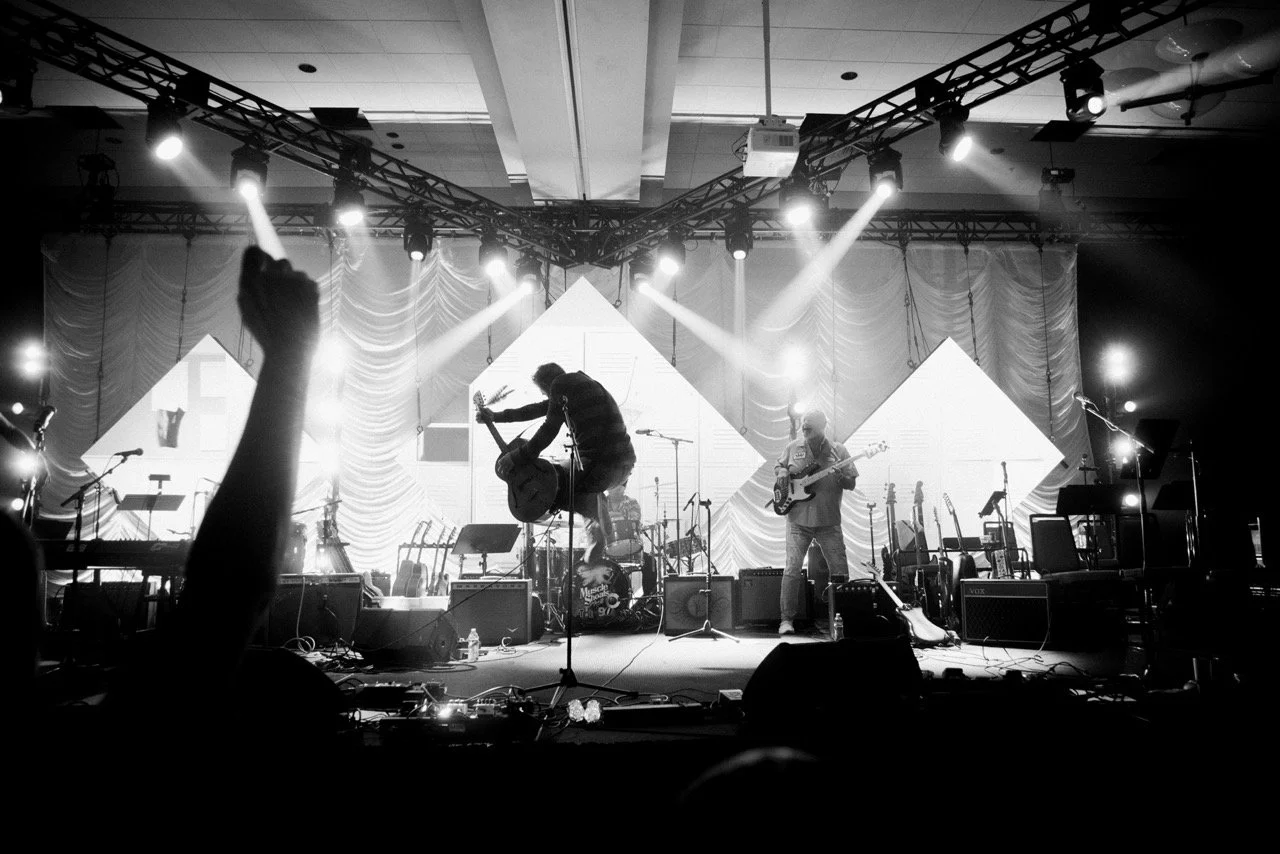
Jamie Barrier in action (photo by Abraham Rowe)
So, when we spoke, I dug into his background and explored what influenced him as a young skateboarder from North Alabama. Although I was loosely aware of his abundance of creative projects, I wanted more insight into the people, shows, and albums that shaped his ethos and his point of view. After an hour-long chat, I discovered you can trace a lot of it back to the house show scene in Auburn in the late-90s and early 2000s.
ACCESSING AUBURN
Given where Auburn stands today – with its neatly cluttered new-build apartments and chain restaurants – it’s hard to imagine that it was ground zero for backyard shows and burgeoning weirdo tunes in Alabama 30 years ago. But it was. When I was an undergrad at Auburn in the mid-2000s, I’d heard the lore about the preceding decade — including a story about Green Day performing in someone’s kitchen — but I hadn’t encountered anyone who actually moved to the town because of its musical reputation. To me, that kind of motivation seemed reserved for places like Athens or Chapel Hill. But Auburn had something going on back then, and Barrier found his way to it.
That discovery came through purchasing Man or Astro-man? 7-inches in Huntsville and hearing word-of-mouth hype about their homebase in Auburn. Motivated and curious, Barrier enrolled at Auburn University after high school with the belief that Southern punks could find something interesting and worthwhile in between cow pastures and Jordan-Hare Stadium.
“When I got to Auburn, it was just a beautiful world of independent records and zines and bands touring the world [and] playing houses,” said Barrier. “There were three different houses I lived in there and… my houses alone probably had 200 bands play in them.”
According to Barrier, Auburn was an eclectic scene, too. It wasn't exclusionary or solely focused on punk or surf or metal. There was funk and roots music and plenty more in the mix. Which made the parties and shows welcoming and ensured different people could collide and connect. With entrepreneurial rule-breakers like Chet Weise of the Immortal Lee County Killers and Brian Teasley of Man or Astro-man? spurring things along, Barrier saw first-hand how to cultivate a scene in a small town.
So, Auburn was the gateway in a sense. It proved to Barrier that a vibrant scene isn’t dependent on formal venues or proximity to a big city. It’s more about building relationships, taking creative risks, avoiding too much structure, and making it easy for people to join in. Those lessons also applied to another Alabama college town where Barrier found alternative ways of doing things: Montevallo, home of Alabama’s only public liberal arts college.
DIY IN MONTEVALLO
Through Montevallo and its unorthodox pizza joint and venue Barnstormers, Barrier connected with Alabama punk godfathers Nowhere Squares and discovered some world-shifting stuff along the way.
“I remember going to Paul Wilm’s [founder and singer of Nowhere Squares]. He had all these Daniel Clowes comic books on his wall and all these Billy Childish records and that was a life changer, you know,” said Barrier.
In addition to Clowes and Childish, Barrier also encountered a three-piece band from Memphis in Montevallo that disrupted some of his notions about stage presence and performing.
“We all went to Barnstormers [and] watched the Oblivions. They melted our faces,” recounted Barrier. “I remember the Oblivions had this tiny beat up car. It looked like their grandma's car… All of our rules, they broke. They didn't do a 20-minute set, it was like two hours. And they were all swapping instruments every three songs… And by the end, the whole room is dancing. It was one of the most amazing things I've ever seen.”
Although Barnstormers was a formal venue, sort of, it still embodied the same unpredictable and welcoming spirit Barrier encountered in Auburn. Plus, Montevallo was even further from the interstate, so the fact that DIY culture was thriving there proved anything was possible.
RETURNING TO FLORENCE
Although both Auburn and Montevallo had a major impact on Barrier, neither town was a good long-term fit for him. Both places are pretty transient as Barrier pointed out, and the people and priorities shift frequently. Given that reality – and his family’s North Alabama roots – he went back to Florence to take a swing at building his own thing and applying some of what he’d learned. But, historically, Florence’s relationship with house shows and punk culture was complicated.
“Every house show we ever tried to do here ended with cops, like, we just didn't… have the discipline,” said Barrier.
The crowds got too rowdy, the neighbors were intolerant, and the scene was too fractured. A tricky combination and a serious departure from the “liberating” atmosphere of Auburn and the write-your-own rules mindset of Montevallo. Barrier didn’t give up, though. He still sought out ways to stir up the potential punks and outsiders in the community using his shop, Black Owl, as a third space and venue for local and touring bands. They weren’t house shows necessarily, but they did have a similar feel. Still, local skepticism hovered, so he had to find alternate ways to promote shows and get people in the door.
“Punk is a misunderstood word. If I'm talking to somebody down the street and handing them a flyer… I don't even use the word ‘punk’ because to them that's like Warped Tour or something. Or it's like spitting in your oatmeal,” said Barrier.
THE K WAY
And even Barrier himself has grappled with and reimagined his definition of punk. Some of that reflection can be attributed to Olympia, Washington’s K Records and its founder Calvin Johnson, who Barrier connected with through booking shows over the years. Johnson’s appreciation for music is far-reaching, as Barrier noted, and includes everything from Dead Moon to an obscure farmer singing Irish folks songs in a barn. Sure, the tempos and volume levels might vary, but, as he learned from Johnson, you can still uncover a shared sensibility rooted in the fundamentals of punk.
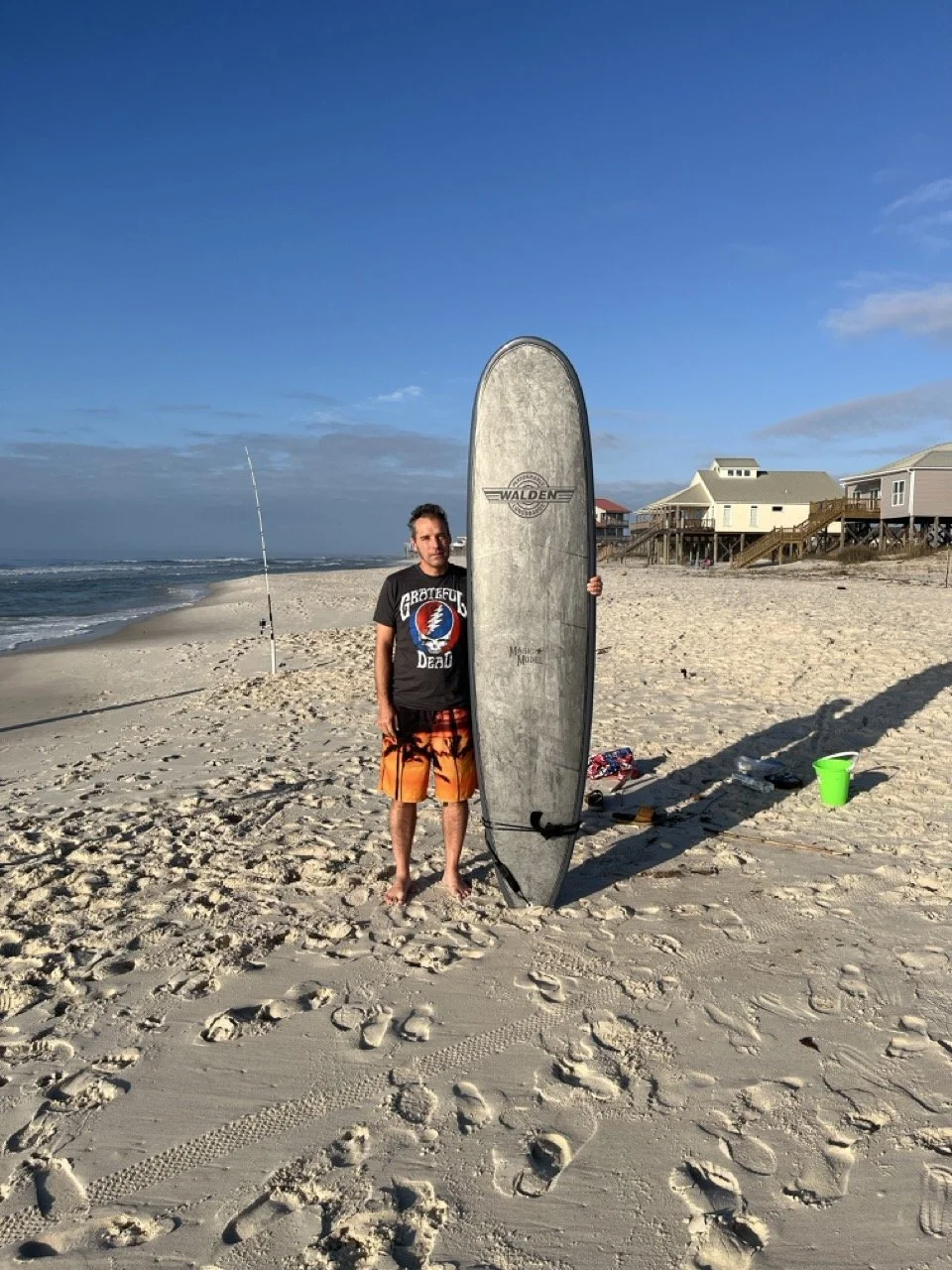
Jamie, a skater and surfer at heart (Travis Hightower)
“There's something with K… it really rewrote the rules of what is punk. It was just much more vast, and I liked that,” said Barrier.
Now, Barrier calls Johnson a friend and occasionally hosts him in Florence (in fact, he was coming to the shop right after our interview). And the bands he works with through his label and shop stretch far beyond what some would classify as “punk rock.” Just listen to The Glue’s album Shot in the Dark, which Barrier released on Arkam last year. It’s beautifully bent bedroom country, akin to the K Records catalog or something you could’ve heard at an Auburn house show in 2000. It’s full circle, in a way.
FRIENDS + COLLABORATORS
As we wrapped up our conversation, Barrier took a minute to highlight some of his favorite Southern bands and collaborators, including Nightmare Boyzzz (he re-released all of their singles and EPs recently), The Dismals (another Arkam band), Hartle Road, Overnight Lows, Walker Yancey, and The Grumpies. Recently, he’s also developed an appreciation for New Orleans trashcan rockers Twisted Teens.
“There's a thread with those guys,” reflected Barrier. “I do feel a kinship. [CP Hollywell, Twisted Teens’ singer] plays old time fiddle, man. I've always loved doing old time fiddle and then having a garage band, too. I've always had a foot in both worlds, trying to figure out how to make it all work. And then all of a sudden here come Twisted Teens.”
To me, kinship really seems to be the thread that spans Barrier’s story — kinship rooted in a shared DIY ethos and belief that no matter where you live, you can create your own fun, subvert traditional ways of doing things, and connect with others along the way. And it doesn’t seem like a stretch to source all of that back to those shows in Auburn nearly 30 years ago. Which, in turn, proves that digging into the history of house shows in Southern college towns might reveal some pretty profound legacies.
